Category Archives: Science

The probability of the extinction of humanity is increasing

As communities overlap more and more, the unanticipated toxins that destroy cultures have a greater likelihood of spreading to other cultures.

When the Roman Empire poisoned itself with lead, for example, it destroyed a large culture, but not everyone. When the plague killed 1/3 of the world’s population, it even impacted the economic prosperity of Africa as the limited trade routes fell apart. If today’s aspartame (or any other component of our environment) were to cause damage to our evolutionary viability, it would vastly destroy the population of the world. Coke, for example, sells to just about every corner of the globe. As this occurs with more foods, drugs, medical procedures, manufacturing byproducts, and societal norms, we increase the likelihood of breaking the chain of humanity.

It may make sense to restrict the propagation of new products at some point in order to protect populations from negative ramifications. It also seems wise to maintain different food and drug administrations in different countries as long as there is unpredictability in long-term implications. The responsibility of the food and drug administration will become more and more important as similar ingredients become a part of the diet of larger and larger part of the population.

Chemical, biological, nuclear, nano-, and genetic weaponry is increasing in effectiveness. It will be possible in the next decades to produce agents that will kill all life with genetic code that matches any set of very specific genetic or other criteria.

This is really scary to me. I don’t know how to stop it. Similar to the way that software viruses and anti-virus software battle for dominance, new weapons and the protections against them will battle for dominance… in this case, with lives on the line. Over time the technology for constructing microscopic, cheap, and effective weapons will become more accessible. Columbine has the potential to be much worse. Assassination could be as easy as sending a nanoterrorist or finding a hair and releasing an airborne virus with a single target. It makes me think something that rarely crosses my mind: that the government should enforce involvement.
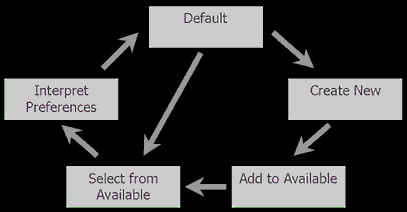
The Evolvor Cycle

I think that the following cycle is an abstraction that applies to many forms of systems and, when implemented, can create very powerful evolutionary dynamics. It actively evolves the underlying system, so I name it ‘Evolvor cycle’.

Applied to a configuration, for example, it would set the original default for new users according to the implied preferences of the existing users. The option to signal new preferences continues the cycle and the default configuration evolves over time without any human administration.

Financial Markets Evolve

Arbitrages – even of very small marginal size – will be eliminated based on a large number of artificially intelligent program trading systems that will mine the historical and currently released information identifying and exploiting trends. The process of the elimination of arbitrage opportunities will create vast concentrations of wealth within the companies that embrace the tools that automate this process. As new information sources become available for analysis, new arbitrages may be identified with increasing complexity. The abstraction of trading systems to automaically test and integrate new data sources will mark the last decades of financially advantageous investment in hedge funds. After that time, return will be a stochastic function of expected risk.

Innovation in the 21st Century

The rate of innovation will continue to increase as communications and transportation help us to conquer time and space. The value of innovation will become quantifiable and attributable – leading to a renaissance in most fields, and a new breed of professional innovators currently being born as a new sector in the consulting industry.

Algorithm for self-improving "telepathic" input system

Concurrently record the output of a brain scan A and standard input devices of keyboard and mouse B. Then neural network N evaluates A, forecasting B. After training with good data populating A and B, the intricacy of the commands and the statistical accuracy will enable a brain-only interface with a breadth of controllability and interactivity speed that will far exceed our current tools.

Initial systems will most likely track eye movement and visceral biofeedback that can be measured using electrodes and buttons.

6/15/2001 – I have received feedback that the brain thinks in words and concepts, rather than the translation to spelled and typed words, and would therefor render this invention useless. However, the input system described above would actually benefit from this characteristic. Inputs should include a rolling period of time and to allow for words or concepts to be interpreted in N over a series of typed inputs.