Tag Archives: software

Competition in the information age

Consolidation is the result of economies of scale – essentially horizontal integration, vertical integration, and resource sharing. These methods create competitive advantages in powerful ways that make it difficult for smaller players to compete in the same markets. There is nothing necessarily wrong with this trend, but it creates large barriers to entry and often leads to larger profit margins than would be otherwise possible.

In the information age – yes, now – this effect is greatly increased, and the limitations of transportation and capacity have been eliminated. The ability to integrate and share resources is much easier, and new extra-strength synergies are created. For example, if a website allows you to shop for both books and music, then it is possible to tailor your music shopping experience based on your book purchasing preferences. This is a very simple example of a much more powerful trend. It may be impossible to enter into any sort of competition with large information companies after the next 20 years.

You can already see it beginning to happen: Yahoo builds from scratch any web business that seems to make sense. Then because of its existing market coverage, and the ability to integrate new businesses with existing businesses and data, Yahoo is able to capture so much synergistic value that they gain an insurmountable competitive advantage. In this way, I think that Yahoo and the other major aggregators and integrators are great companies.

There are risks. Big ones. And the FTC may not be able to do anything about it.

It may be inevitable that the consolidation will lead to a stable equilibrium under monopoly – where there would be no reason to be a competitor because the types of services being provided rely on historical information and broad business integration that is impossible to recreate or beat. Then this monopolist would have virtually limitless pricing discretion, and the ability to manipulate markets and cultures in unprecedented ways. Humanity, in many ways, would be at the mercy of the monopolist. (I hope that its leaders are benevolent democrats with philosophically sound motivations and long time horizons – but what if they are not?)

The only way to eliminate this market dynamic is to eliminate the factors that make it possible, namely, the opportunity to use your market dominance in one field to create dominance in another field. More specifically, eliminate the competitive advantage created by archival data. This can be accomplished by sharing archival data freely. But what about my privacy? Good question. We have a big problem here. The private information about you and your preferences plays a large role in creating the value that leads to this consolidation. If you want to eliminate this competitive advantage, then you either eliminate the value or you share private information.

There is another way.

What if users owned their own archival data? Amazon could still track my click streams, and do whatever they wanted with them. But I would also be tracking my own use, and have control over my own preferences and historically available data. Amazon would quickly learn that the personalization algorithms produce much more valuable customization using the users’ data than the Amazon archives. Market entry for this standard benefits from this implication. Now what happens if you go to a small competitor – one with little history, but better value than the others? They would be able to provide you with services that took advantage of your archival data, just as the monopolist would have. Competition is restored, and the advantages for humanity are regained as well.

Somebody should create a standard – probably using an XML document editable from within your browser. I’d love to help. Somebody has to do it eventually, and the sooner the better for all of us (except the monopolist, of course!)
The Changing Face of the Software Industry

When the world seems too wide for purely individual effort, craftsmen of all sorts spring up to specialize. Specialization and trade bring the world to a better level of productivity, and encourage innovation in endlessly narrowing fields. The same dynamic will take hold in the software industry, but this time the wires are the trade channels, and the coders are the craftsmen. Systems will become independent, allowing plug-in applications, interfaces, drivers, and other components; just as monitors are interchangeable now. Large teams of coders will be able to work together without understanding the details of the others’ work. This will be enabled by standardized information interfaces between modular functional components.

The number of programmers will increase in total, but a smaller number will produce broadly adopted code. These few will be developing applications that are web-served and integrated through standard information interfaces with a large system of other applications.

ASPs will emerge that offer as much computing as consumers in each market demand. The software will run centrally, and deliver the services that are traditionally performed by the operating system. Individuals and companies will be able to research, create, manage, and distribute information of all kinds in an efficient and commercial manner. Information access will be intuitive, and input devices will learn to recognize your intentions based on your patterns. A small number of ASPs will emerge after a great competitive consolidation war. The winner will be the architecture that is best able to serve and keep the public’s mindshare through adoption tools, distribution tools, and financial tools, and competitive tools.

  • Adoption tools include a visual interface, intuitive navigation and control, ease of use and editing, and other systems that encourage a habit of use. This opens the door of market entry for a scaleable service.
  • Distribution tools refer to the systems used to place adoptability in the perceptions of the optimal target marketing. The ASP nature of this software technology trend will merge the functions of marketing, sales, advertising, and PR.
  • The approach to the financial tools will determine the incentives for the use and support of the system. Contributors of new valuable information will be paid to encourage their contributions. Service providers of various kinds will be paid for their time, effort, expenses, and access to their information. All types of files and assets will be transactable for money, credit, or barter. Transactions will take place across borders — encouraging legal, pricing, and tax parity.
  • Competitive tools include personalization, aggregation, integration, and any other activity that increases the added value of the service or increases the burden of changing services. These tools will, in many cases, retain users in inferior systems until the value proposition becomes very strong. And by then it is too late for the inferior system to catch up.

Competition will continue to exist in the hosted computing industry for many years as an overwhelming breadth of media and services shocks the human race with an information overload. Cultures will specialize and form media, financial, and service niches. Interfaces will develop to increase speed and resolution until we can no longer tell the difference.

Musical Collaboration by Opt-in and Mass Beat Channels

There could be channels for each beat/tempo, and an unlimited number of contibutors could participate in the creation of music within each channel. Any listener could select the combination of contributors and listen to the mixed track. Popular and preset groups could simplify selection, and descriptive fields for contributors could help improve custom selections. Contributor-defined sub-channels could branch off from the public ones. This system would allow unlimited musical collaboration in a way that provides compatibility and flexibility on a global scale.

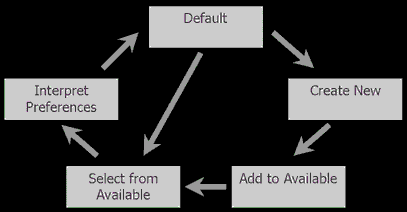
The Evolvor Cycle

I think that the following cycle is an abstraction that applies to many forms of systems and, when implemented, can create very powerful evolutionary dynamics. It actively evolves the underlying system, so I name it ‘Evolvor cycle’.

Applied to a configuration, for example, it would set the original default for new users according to the implied preferences of the existing users. The option to signal new preferences continues the cycle and the default configuration evolves over time without any human administration.

Virtual Earth

Automatic generation of Virtual Earth using multiple input cameras, GPS, image recognition, and interactive identification and definition of Virtual objects. Storage area networks store the many files.