Category Archives: Tech

The Changing Face of the Software Industry

When the world seems too wide for purely individual effort, craftsmen of all sorts spring up to specialize. Specialization and trade bring the world to a better level of productivity, and encourage innovation in endlessly narrowing fields. The same dynamic will take hold in the software industry, but this time the wires are the trade channels, and the coders are the craftsmen. Systems will become independent, allowing plug-in applications, interfaces, drivers, and other components; just as monitors are interchangeable now. Large teams of coders will be able to work together without understanding the details of the others’ work. This will be enabled by standardized information interfaces between modular functional components.

The number of programmers will increase in total, but a smaller number will produce broadly adopted code. These few will be developing applications that are web-served and integrated through standard information interfaces with a large system of other applications.

ASPs will emerge that offer as much computing as consumers in each market demand. The software will run centrally, and deliver the services that are traditionally performed by the operating system. Individuals and companies will be able to research, create, manage, and distribute information of all kinds in an efficient and commercial manner. Information access will be intuitive, and input devices will learn to recognize your intentions based on your patterns. A small number of ASPs will emerge after a great competitive consolidation war. The winner will be the architecture that is best able to serve and keep the public’s mindshare through adoption tools, distribution tools, and financial tools, and competitive tools.

  • Adoption tools include a visual interface, intuitive navigation and control, ease of use and editing, and other systems that encourage a habit of use. This opens the door of market entry for a scaleable service.
  • Distribution tools refer to the systems used to place adoptability in the perceptions of the optimal target marketing. The ASP nature of this software technology trend will merge the functions of marketing, sales, advertising, and PR.
  • The approach to the financial tools will determine the incentives for the use and support of the system. Contributors of new valuable information will be paid to encourage their contributions. Service providers of various kinds will be paid for their time, effort, expenses, and access to their information. All types of files and assets will be transactable for money, credit, or barter. Transactions will take place across borders — encouraging legal, pricing, and tax parity.
  • Competitive tools include personalization, aggregation, integration, and any other activity that increases the added value of the service or increases the burden of changing services. These tools will, in many cases, retain users in inferior systems until the value proposition becomes very strong. And by then it is too late for the inferior system to catch up.

Competition will continue to exist in the hosted computing industry for many years as an overwhelming breadth of media and services shocks the human race with an information overload. Cultures will specialize and form media, financial, and service niches. Interfaces will develop to increase speed and resolution until we can no longer tell the difference.
The probability of the extinction of humanity is increasing

As communities overlap more and more, the unanticipated toxins that destroy cultures have a greater likelihood of spreading to other cultures.

When the Roman Empire poisoned itself with lead, for example, it destroyed a large culture, but not everyone. When the plague killed 1/3 of the world’s population, it even impacted the economic prosperity of Africa as the limited trade routes fell apart. If today’s aspartame (or any other component of our environment) were to cause damage to our evolutionary viability, it would vastly destroy the population of the world. Coke, for example, sells to just about every corner of the globe. As this occurs with more foods, drugs, medical procedures, manufacturing byproducts, and societal norms, we increase the likelihood of breaking the chain of humanity.

It may make sense to restrict the propagation of new products at some point in order to protect populations from negative ramifications. It also seems wise to maintain different food and drug administrations in different countries as long as there is unpredictability in long-term implications. The responsibility of the food and drug administration will become more and more important as similar ingredients become a part of the diet of larger and larger part of the population.

Chemical, biological, nuclear, nano-, and genetic weaponry is increasing in effectiveness. It will be possible in the next decades to produce agents that will kill all life with genetic code that matches any set of very specific genetic or other criteria.

This is really scary to me. I don’t know how to stop it. Similar to the way that software viruses and anti-virus software battle for dominance, new weapons and the protections against them will battle for dominance… in this case, with lives on the line. Over time the technology for constructing microscopic, cheap, and effective weapons will become more accessible. Columbine has the potential to be much worse. Assassination could be as easy as sending a nanoterrorist or finding a hair and releasing an airborne virus with a single target. It makes me think something that rarely crosses my mind: that the government should enforce involvement.

Global economic downturns are amplified by global communications and consolidation of media

Economic downturns are the result of coincident reductions in financial investments. They are marked by larger numbers of companies cutting back on their budgets, and by large numbers of investors who perceive value to be falling. When one individual makes a decision, it has negligible impact on the market (unless it’s Buffet!), but when large numbers of individuals act at the same time, the market moves. The more people are making the same decision at the same time, the equilibrium is shocked by more, too. In other words, the invisible hand becomes an invisible linebacker; pushing harder.

This means that when larger groups of people are influenced in the same ways by the same media, then the market and the economy are going to swing with greater magnitude.

Social inconsistency provides a healthy dissonance in the economic markets. Different consumer confidence levels and uncorrelated investment views ensure that the economic growth remains relatively stable. Just like many stocks in an index reduce the volatility of the index relative to the average volatility of the index components.

So, ironically, by improving the communications tools that make our economy function better, we are also increasing the magnitude and danger of economic downturns.

Musical Collaboration by Opt-in and Mass Beat Channels

There could be channels for each beat/tempo, and an unlimited number of contibutors could participate in the creation of music within each channel. Any listener could select the combination of contributors and listen to the mixed track. Popular and preset groups could simplify selection, and descriptive fields for contributors could help improve custom selections. Contributor-defined sub-channels could branch off from the public ones. This system would allow unlimited musical collaboration in a way that provides compatibility and flexibility on a global scale.

The Evolvor Cycle

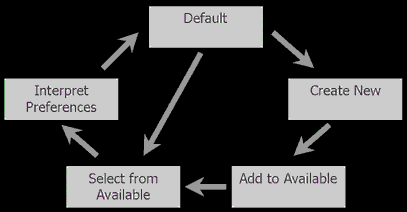
I think that the following cycle is an abstraction that applies to many forms of systems and, when implemented, can create very powerful evolutionary dynamics. It actively evolves the underlying system, so I name it ‘Evolvor cycle’.

Applied to a configuration, for example, it would set the original default for new users according to the implied preferences of the existing users. The option to signal new preferences continues the cycle and the default configuration evolves over time without any human administration.